When Bubble Isn't Enough: How We Extended a No-Code MVP with Custom Code APIs
Listen to this article
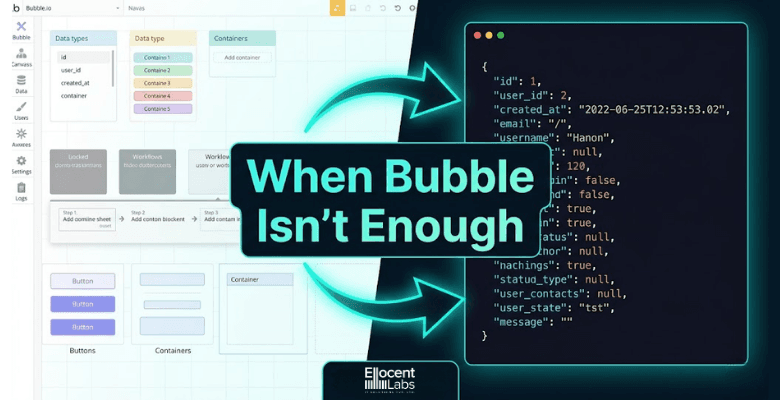
If your Bubble.io MVP is slowing down, breaking under load, or raising red flags in investor conversations, you don't need to rebuild from scratch. Ellocent Labs extends Bubble apps with custom code APIs — so your product scales without starting over, and your team owns the critical parts.
The Moment Every Bubble Founder Dreads
It usually happens quietly. Your MVP is live. Users are signing up. The feedback is good. You've validated your idea, and growth is ticking upward. Then, somewhere between user number 200 and user number 800, things start creaking.
Workflows that used to fire in a second now stall. A critical API call times out and takes your entire feature chain with it. A new integration you promised a client? It turns out Bubble can't quite bend the way you need it to. And that investor you pitched last week? They asked a pointed question about your "tech stack" that you fumbled through.
This isn't a failure story. This is actually the best problem a founder can have — it means your product works. But it does mean you've officially outgrown what Bubble was designed to do at its best: get you to proof of concept, fast.
At Ellocent Labs, we work with founders, CTOs, and product teams who've hit exactly this wall. And our answer is almost never "burn it down and rebuild from scratch." Our answer is smarter — extend what you have with custom code APIs that pick up precisely where Bubble leaves off.
What Does Bubble.io Actually Do Well?
Bubble.io is the fastest way to launch a functional, database-backed web application without a full engineering team. Its visual builder, plugin marketplace, and built-in backend let non-technical founders validate ideas in weeks — not months — at a fraction of traditional development costs. For MVP-stage products, it remains one of the most powerful tools available in 2026.
Let's be clear: Bubble.io is genuinely impressive for what it's built for. For a non-technical founder or a startup without a dev team on payroll, it offers something that used to take months and significant capital — a working, database-backed web application, built visually, in weeks.
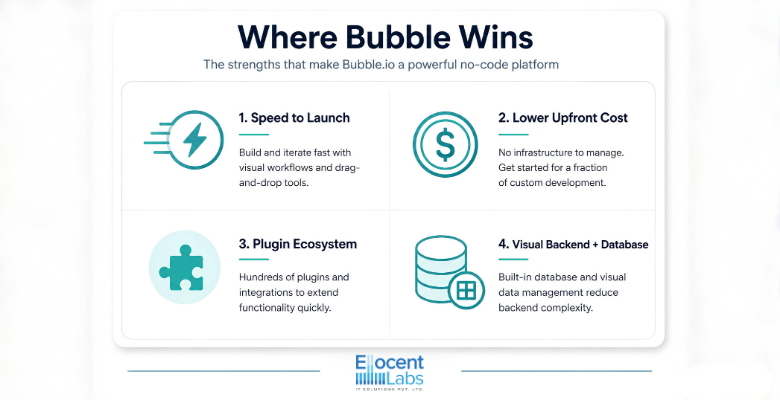
The platform's visual editor handles both frontend and backend in one environment. Its plugin marketplace lets you snap in payments (Stripe), authentication, analytics, and hundreds of third-party integrations without writing a single line of code. It even supports API connectors out of the box, which means many basic integrations are achievable in pure no-code.
For MVPs, this is exactly what you need. You're not optimising for performance — you're optimising for speed of learning. And Bubble is very good at that.
Real companies have validated multi-million-dollar business models on Bubble before replatforming. The no-code MVP approach is not a shortcut — it's a legitimate and strategic first step. The issue is knowing when that first step has taken you as far as it can.
What Are the Real Limits of Bubble.io at Scale?
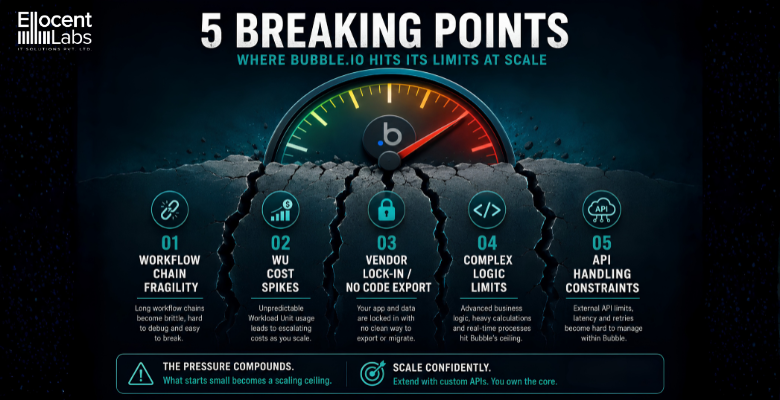
Bubble.io hits hard structural limits as products grow: workflow execution timeouts, unpredictable Workload Unit (WU) cost spikes, no code export or ownership, inability to handle complex authentication flows, and fragile API chains. As of 2026, these constraints make custom API integration essential for any startup preparing to scale beyond early traction.
Here are the five breaking points we see most often:
1. Workflow Complexity and Chain Fragility
Bubble's workflows are powerful but sequential. When you start building logic that spans 15, 20, or 30 steps — conditional branches, external API calls, database writes, error handling — you've built a chain where any single broken link fails everything. One timeout on an external API call, and your entire workflow crashes silently.
As of 2026, Bubble's hard limits on workflow execution time and backend processing remain a structural constraint. You can optimise around them, but you can't engineer past them within the platform itself.
2. Workload Unit (WU) Costs at Scale
Bubble's pricing model charges Workload Units for everything your app does — queries, writes, API calls, page loads. At MVP scale, this is negligible. At growth scale, it becomes a meaningful cost line that rises faster than your revenue in ways that are hard to predict or control.
Founders often describe hitting an "invisible ceiling" where scaling their user base causes WU consumption to spike suddenly, forcing a plan upgrade with pricing that isn't designed for how real products scale.
3. Vendor Lock-In and No Code Export
This is the one that makes investors nervous. Bubble does not export your code. Your entire application logic lives inside Bubble's proprietary system. If Bubble changes its pricing, deprecates a feature, or experiences downtime, you have limited options. You don't own your codebase — you're renting it.
For startups preparing for Series A or seeking acquisition conversations, this becomes a genuine due diligence red flag. Buyers and investors want to see codebase ownership, a clear engineering path, and portability. Bubble apps require a management conversation that custom-code applications do not.
4. Complex Business Logic That No-Code Simply Can't Express
Some business rules are just too nuanced for a visual workflow builder. Multi-tiered pricing engines, real-time scoring systems, complex data transformation pipelines, compliance-heavy logic with audit trails — these require the kind of precise, testable, version-controlled code that no-code tools weren't designed to handle.
When your product logic outgrows what Bubble's workflow editor can cleanly express, you end up with unmaintainable spaghetti workflows that no new developer (no-code or otherwise) can confidently touch.
5. Third-Party Integrations That Require Custom Handling
Bubble's API Connector is capable — but it works within Bubble's rules. If an external API requires custom authentication flows, webhook signature verification, binary data handling, rate-limit management, or real-time streaming, you'll quickly find yourself working around Bubble's abstractions rather than building productively.
Custom APIs written in Node.js, Python, or similar languages handle these scenarios natively, cleanly, and with full control over error handling, retries, and logging.
How Does a Hybrid Bubble + Custom API Architecture Actually Work?
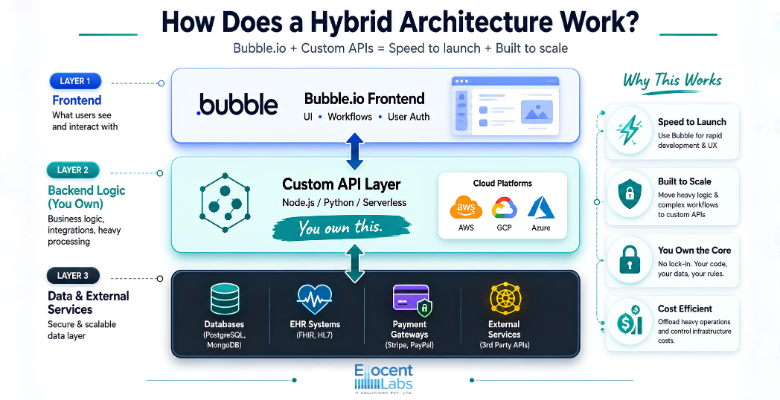
A hybrid architecture keeps Bubble.io as the frontend and basic workflow layer, while offloading complex logic, heavy integrations, and performance-sensitive operations to custom-built API services hosted on AWS, Google Cloud, or Azure. Bubble calls these custom endpoints exactly like any third-party API — the user experience is seamless, but the critical logic now lives in code your team owns.
Here's how the hybrid model works in practice:
- Bubble remains your presentation layer and basic orchestration tool — UI, simple workflows, user auth, standard database reads
- A custom API layer (hosted on AWS Lambda, Google Cloud Run, or Azure Functions) handles everything compute-heavy, logic-complex, or integration-sensitive
- Your Bubble app calls your custom API endpoints just like it calls any other external service — seamlessly, without the user knowing anything changed
This approach gives you:
- Performance headroom — Custom APIs execute in milliseconds without WU billing
- Logic expressiveness — Write any business rule you can imagine, in real, testable code
- Ownership — Your API layer belongs to you, regardless of what Bubble does
- Investor confidence — You can demonstrate a clear technical path forward
- Incremental migration — Gradually move logic out of Bubble at your own pace, no big-bang rewrite required
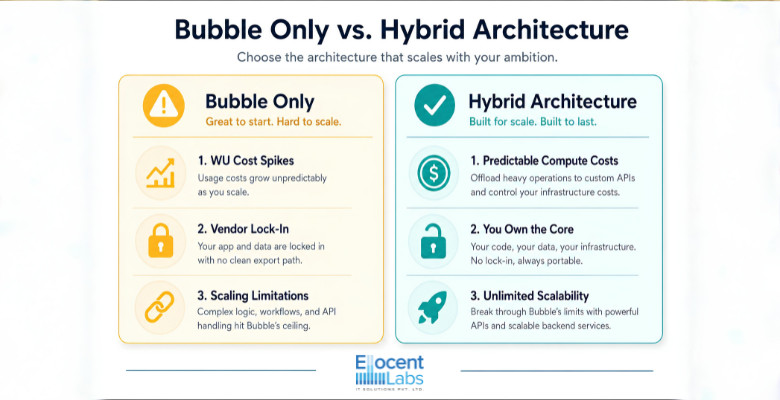
Bubble-Only vs. Hybrid Architecture: A Direct Comparison
| Dimension | Bubble-Only | Hybrid: Bubble + Custom APIs |
|---|---|---|
| Performance at scale | Degrades with WU spikes and workflow timeouts | Stable — custom APIs run independently of Bubble's limits |
| Business logic complexity | Limited to visual workflow builder | Unlimited — write any logic in Node.js, Python, or preferred stack |
| Cost predictability | WU costs spike unpredictably with growth | Compute costs are predictable and separable from Bubble plan tiers |
| Code ownership | None — logic lives in Bubble's proprietary system | Full — custom API layer is yours to version, test, and migrate |
| Third-party integrations | Limited by Bubble's API Connector rules | Unlimited — handle HMAC auth, binary data, streaming, webhooks natively |
| Investor/acquisition readiness | Raises due diligence concerns about lock-in | Demonstrates engineering path and codebase ownership |
| Migration path | Full rebuild required if leaving Bubble | Incremental — move services out of Bubble gradually over time |
| Time to implement | Fast for MVP | Weeks to add custom API layer — not months |
Key Takeaways: The Hybrid Migration Process Blueprint
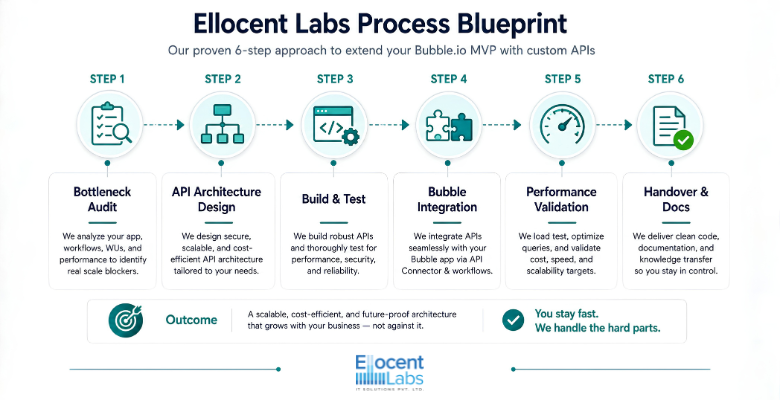
When Ellocent Labs extends a Bubble app with custom APIs, we follow a structured process that minimises disruption and maximises speed:
Step 1 — Bottleneck Audit
Identify the specific Bubble workflows, integrations, or features causing performance issues, logic errors, or WU cost spikes. We map each pain point to a custom API candidate.
Step 2 — API Architecture Design
Design the custom API layer: endpoints, data contracts, authentication strategy, and hosting environment (AWS, GCP, or Azure). This is where the architecture diagram is produced and signed off.
Step 3 — Build & Test Custom Services
Develop the custom API services in Node.js or Python. Each service is independently tested, version-controlled in Git, and documented before it touches your live Bubble app.
Step 4 — Bubble Integration
Connect Bubble to the new API endpoints via the API Connector. Existing Bubble workflows are updated to call the custom services. No UI changes. No user disruption.
Step 5 — Performance Validation
Run load tests and monitor WU consumption, response times, and error rates. Validate that the bottlenecks identified in Step 1 are resolved.
Step 6 — Handover & Documentation
Your team receives full documentation of the API layer, deployment guides, and a roadmap for any further migration steps if needed.
What This Looks Like in Practice
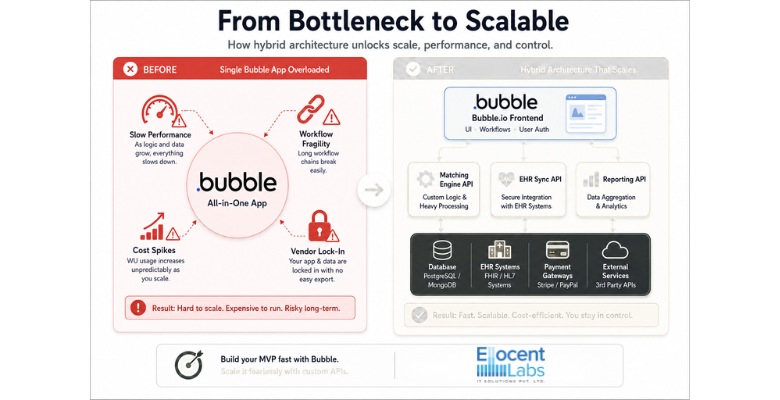
Consider a SaaS platform built on Bubble for a healthcare services company — a real scenario we've worked through at Ellocent Labs. The MVP worked beautifully: providers could create profiles, patients could book appointments, and a basic CRM was in place. Bubble handled it all.
But as the platform grew, three problems converged. First, the matching algorithm — pairing patients to providers based on dozens of variables — was growing unmanageably complex as a Bubble workflow. Second, the platform needed to sync with an external EHR (Electronic Health Records) system via an API that required HMAC-signed requests, something Bubble's connector couldn't handle natively. Third, the data reporting requirements meant pulling and aggregating thousands of records in ways that consistently hit Bubble's performance limits.
The solution wasn't a full rebuild. Instead, we built a custom API layer — a set of lightweight, serverless endpoints — that Bubble called for each of these three specific functions. The matching logic became a clean Python function. The EHR integration was handled by a Node.js service that managed authentication and data normalisation. The reporting queries ran against a dedicated data layer, not Bubble's database.
The Bubble frontend stayed intact. Users noticed nothing except that the platform got faster. The development team suddenly had a codebase they could test, version, and scale. And when the company entered acquisition conversations, the hybrid architecture was presented as a strategic asset, not a liability.
This is the Ellocent Labs approach: custom software solutions that meet you where you are, rather than where we'd like you to start from.
When Should You Extend Bubble vs. Migrate Fully?
The right answer depends on where your bottlenecks are, not how long you've been on Bubble. Extend with custom APIs when you have specific, fixable pain points and a working frontend. Plan a full migration only when your entire architecture has outgrown no-code — which for most products is much later than founders expect.
Not every Bubble pain point needs a custom API. Here's the framework we use with clients:
Stay on Bubble (for now) when:
- You're still finding product-market fit and need to iterate rapidly
- Your user base is under a few hundred active users
- Your workflows are manageable and your WU costs are predictable
- You're not integrating with systems that require complex API handling
Extend with custom APIs when:
- You have specific, identifiable bottlenecks (performance, logic, integration)
- You need one or two complex features that Bubble can't cleanly handle
- You want to reduce WU costs on high-volume operations
- You're preparing for investor conversations and need to demonstrate code ownership
Plan a full migration when:
- Your entire application architecture has outgrown no-code
- Compliance, security, or governance requirements demand it
- The cost of maintaining Bubble workarounds exceeds the cost of rebuilding
- Your team has the engineering capacity to manage a full custom stack
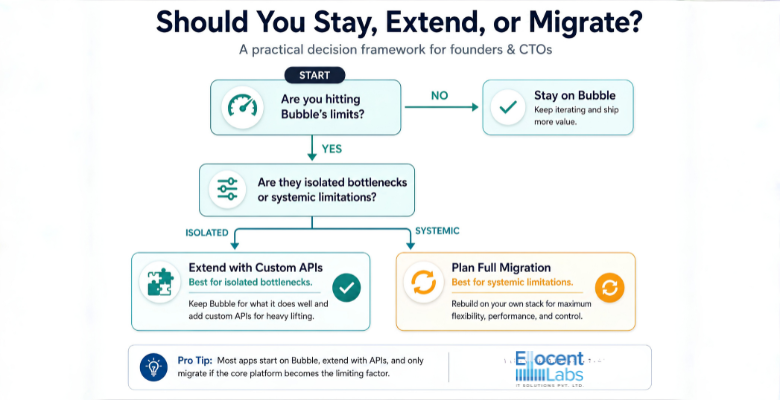
The hybrid model is almost always the right answer at the "extend" stage — and that stage lasts longer than most founders expect. A well-designed API extension can comfortably support a product through millions of users before a full migration becomes necessary.
Frequently Asked Questions
Can Bubble and custom APIs really work together without issues?
Yes. Bubble's API Connector lets you call any REST API endpoint, meaning your custom services integrate with Bubble exactly like any third-party service would. The separation is clean, and Bubble handles it natively.
Do I need a full engineering team to build a custom API layer?
Not at the extension stage. A focused engagement with a custom software team — like Ellocent Labs — to build two or three critical API services can be completed in weeks, not months, and requires no ongoing full-time engineering headcount to maintain initially.
Will adding custom APIs break my existing Bubble app?
Done correctly, no. The Bubble frontend continues to function as before. Custom API calls are additive — they don't replace what's working, they extend it.
What languages and stacks do you use for the custom API layer?
At Ellocent Labs, we work across Node.js, Python, and cloud-native serverless architectures on AWS, Azure, and Google Cloud, depending on your existing environment and performance requirements.
How long does it take to build a custom API layer on top of Bubble?
For a targeted extension — typically 2–4 specific API services addressing the main bottlenecks — expect 3–6 weeks from audit to production. More complex integrations may take 8–12 weeks. Either way, it's faster and less risky than a full rebuild.
Ready to Take Your MVP Further?
Bubble gave you the speed to launch. Custom APIs give you the power to scale. The good news is you don't have to choose between them — at least not yet.
At Ellocent Labs, our team specialises in exactly this kind of pragmatic, non-disruptive extension work. We've helped founders and product teams extend, optimise, and future-proof no-code products with custom API layers built to grow with them — not against them.
If you've hit a wall with Bubble, or you can see one coming, let's talk before the pressure is on.
Not sure which approach is right for your project?
We've built both. We'll tell you honestly which one fits.
From no-code MVPs validated in 6 weeks to enterprise AI platforms with 50,000+ users, we've built across the whole range. Book a consultation and we'll tell you honestly which approach fits your budget, your timeline, and your scale ambitions.
Book a discovery call