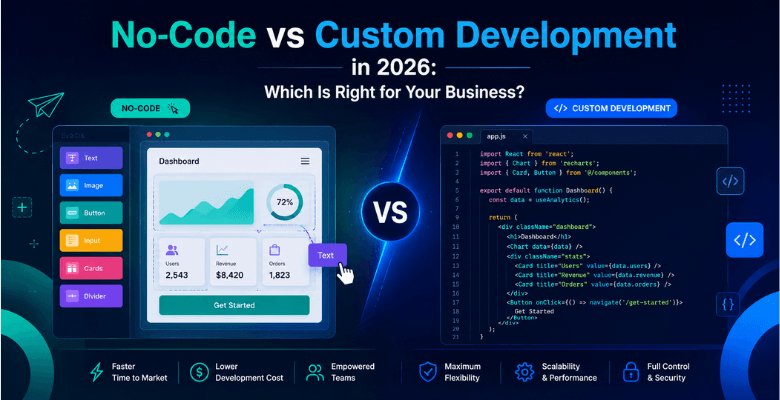
No-Code vs Custom Development in 2026: Which Is Right for Your Business?
Listen to this article
A practitioner's guide to choosing between no-code platforms, custom development, and the hybrid approach — with real costs, a 10-minute decision framework, and an honest account of where each approach breaks down.
No-code platforms like Bubble are the right choice for MVPs under $30K where speed of validation matters more than scale. Custom development is the right call when your software is the product itself, when you need specific integrations that no-code cannot support, or when you expect to exceed 10,000 active users within 12 months. In 2026, the smartest approach for most businesses is neither — it is a deliberate hybrid: no-code to validate, custom to scale. The most expensive decision in software development is not choosing the wrong tool. It is choosing the right tool for the wrong stage of your business.
About the Author
This post is written by the development team at Ellocent Labs IT Solutions, with direct experience across 40+ software projects including no-code MVPs built on Bubble, custom AI platforms for UK healthcare clients, and hybrid SaaS products for Australian fintech startups. Where we cite data, we link to the source.
This post is written by the development team at Ellocent Labs IT Solutions, with direct experience across 40+ software projects including no-code MVPs built on Bubble, custom AI platforms for UK healthcare clients, and hybrid SaaS products for Australian fintech startups. Where we cite data, we link to the source.
If you have ever tried to decide between building your product on a no-code platform or investing in custom development, you already know the problem. Every article you read seems to have a clear answer. The no-code evangelists say it is always faster and cheaper. The custom development agencies say no-code will box you in. Neither side is being fully honest with you.
This guide cuts through the noise with real numbers, a clear decision framework, and — because we have built both — an honest account of where each approach breaks down.
What Has Actually Changed in 2026?
The no-code vs custom development debate looks different in 2026 than it did two years ago. Three shifts matter:
- AI-assisted development has compressed the cost and time gap. A skilled developer using tools like Cursor or GitHub Copilot can now produce a custom MVP in 3–6 weeks at costs that were previously only achievable with no-code. The price advantage of no-code has narrowed significantly.
- No-code platforms have matured — but so have their limitations. Bubble, Retool, and AppSheet are genuinely powerful for standard applications. But the ceiling has not moved. Performance, deep customisation, and complex integrations still hit the same walls they always did.
What Is No-Code Development?
No-code platforms let you build functional software without writing traditional code. You use visual editors, drag-and-drop interfaces, and pre-built logic blocks to construct apps, databases, and workflows.
In 2026, the leading no-code platforms include:
- Bubble — web apps and MVPs with database logic
- Retool — internal tools and dashboards
- Webflow — marketing sites and content-driven web experiences
- AppSheet — mobile apps from spreadsheet data
- Glide — simple mobile and web apps from Google Sheets
What Is Custom Development?
Custom development means building software from scratch using programming languages (Python, JavaScript, React, Node.js, etc.), databases (PostgreSQL, MongoDB), and infrastructure (AWS, GCP, Azure). Every line of code is written, owned, and controlled by your team or your development partner.
In 2026, AI-assisted development tools have changed what custom development looks like in practice — the process is faster, but the output remains fully owned, portable code without platform dependency.
How Much Does Each Approach Actually Cost?
| Cost Factor | No-Code | Custom Development |
|---|---|---|
| MVP Build Cost | $5,000–$30,000 | $25,000–$80,000 (AI-assisted), $80,000–$200,000 (traditional) |
| Monthly Platform Fee | $100–$500/month (ongoing) | $0 (you own the code) |
| Scaling Cost | Increases with users/plan tier | Infrastructure cost only — predictable |
| Rebuild Cost When You Outgrow It | Often $50,000–$150,000 to migrate | Not applicable — you own and extend it |
| Developer Maintenance | Requires no-code specialist knowledge | Standard developer skills — larger talent pool |
| Year 1 Total (typical startup MVP) | $15,000–$45,000 | $35,000–$90,000 |
| Year 3 Total Cost of Ownership | Often MORE expensive due to fees + rebuild | Usually LESS expensive — no platform fees |
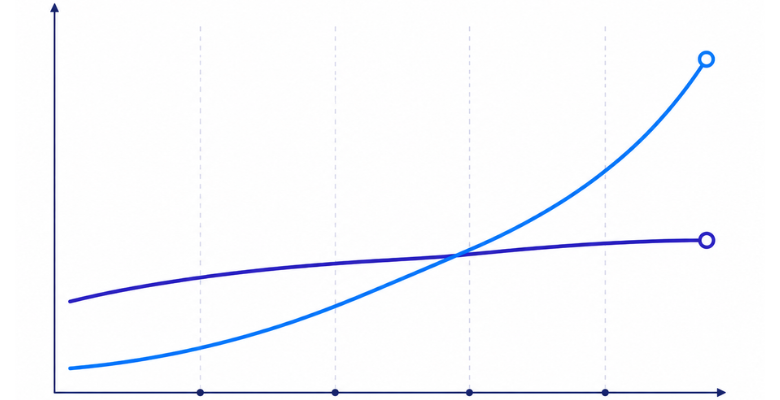
The uncomfortable truth: No-code is cheaper in Year 1. Custom development is usually cheaper in Year 3. The break-even point depends entirely on your growth rate and how quickly you outgrow the platform’s ceiling.
Where No-Code Wins
No-code is genuinely the right choice in specific situations. Here is where it wins:
1. You Are Validating an Idea, Not Building a Business
If you do not yet know whether anyone will pay for your product, do not spend $80,000 on custom development to find out. No-code lets you build a working prototype in days, put it in front of real users, and learn whether you have a business — before you have sunk your budget into the wrong product.
This is the original and still strongest use case for no-code. Spend $5,000–$20,000 to validate. Then invest in custom engineering once you know exactly what to build.
2. You Are Building an Internal Tool, Not a Customer-Facing Product
An internal dashboard for your operations team, a CRM customisation, a reporting tool — these are ideal no-code use cases. They do not need to scale to thousands of concurrent users. They do not compete on performance. They just need to work reliably for 10–50 people inside your company.
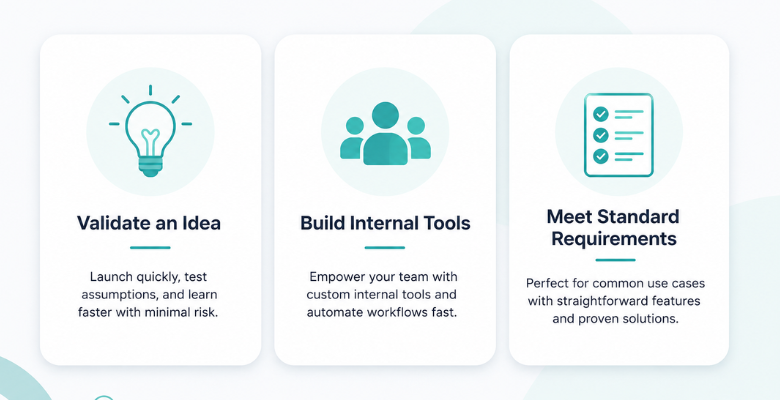
3. Your Requirements Are Standard
Forms, workflows, databases, dashboards, simple integrations — no-code platforms were designed for exactly these tasks. If your application does not require anything unusual, no-code will build it faster and cheaper.
Where Custom Development Is Non-Negotiable
No-code has real ceilings. Here is where it breaks down and custom development becomes necessary:
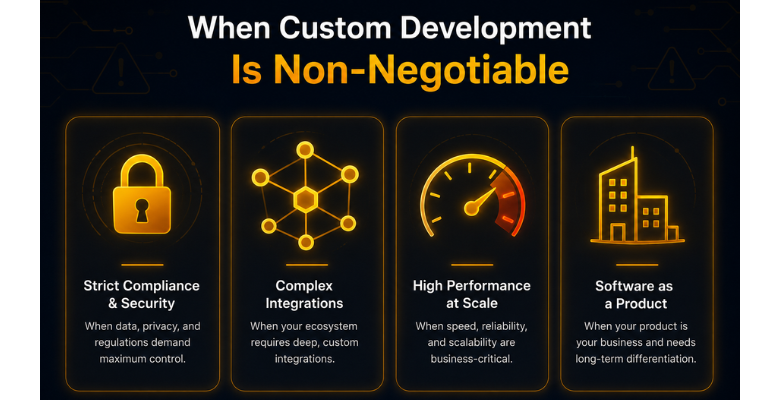
1. Your Software IS the Product
If you are building a SaaS platform that you plan to sell to other businesses, the software itself is your competitive advantage. No-code platforms make your competitive advantage dependent on another company’s pricing decisions, roadmap, and terms of service. That is an existential risk.
We saw this directly with a client who had built their recruitment automation platform on Bubble. When they hit 5,000 active users, Bubble’s plan costs made the business model unviable. A full rebuild was required — at three times the original build cost.
2. You Have Specific Integration Requirements
No-code platforms work well with standard integrations (Stripe, Zapier, Airtable). When you need deep, real-time integrations with legacy enterprise systems, custom APIs, or proprietary data sources, no-code hits its limit quickly. The workarounds become more expensive than the custom solution.
3. You Handle Sensitive Data or Need Regulatory Compliance
Healthcare data (HIPAA, Australian Privacy Act), financial data (PCI-DSS), or any application requiring air-gapped infrastructure cannot be reliably built on no-code platforms where your data sits on a third-party server. Custom development with your own infrastructure is the only viable path.
4. You Expect High Traffic or Complex Performance Requirements
No-code platforms degrade under load. When you are processing thousands of concurrent requests, running complex database queries, or serving global users with low latency requirements, custom-built infrastructure on AWS, GCP, or Azure will significantly outperform any no-code solution.
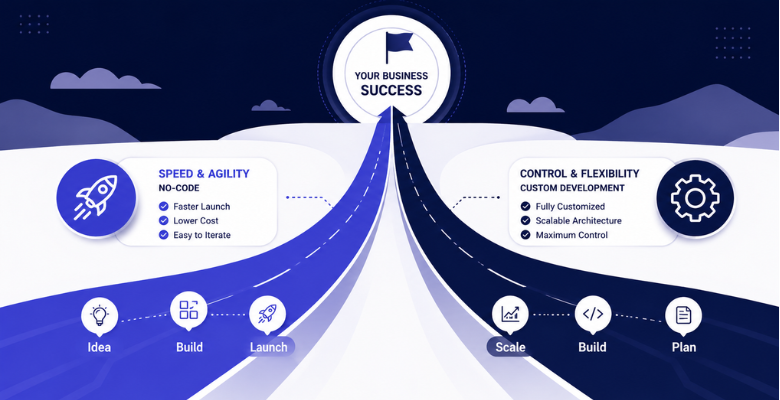
The Hybrid Approach — What Most Successful Products Actually Do in 2026
The Pattern That Works
Phase 1 (Months 1–3): Build the MVP on no-code. Validate product-market fit. Cost: $10,000–$25,000.
Phase 2 (Months 4–12): Identify the 2–3 components that are hitting no-code’s ceiling. Rebuild those in custom code while keeping the rest on no-code.
Phase 3 (Year 2+): Progressively migrate core features to custom as the business scales and no-code limitations compound.
This is not a compromise — it is a deliberate strategy. The companies that skip Phase 1 and build everything custom from day one waste capital proving product-market fit with expensive infrastructure. The companies that stay entirely on no-code into Phase 3 rebuild everything at enormous cost.
We built the Ellocent Labs AI recruitment platform for a UK client using exactly this pattern. The initial MVP was built on Bubble in 6 weeks. When the client secured funding and needed to scale to enterprise clients with ISO 27001 compliance requirements, we rebuilt the core matching engine and data layer in Python and Node.js — while keeping the front-end CMS on no-code to save time and cost. That decision saved approximately $40,000 in development cost compared to rebuilding everything from scratch.
The 10-Minute Decision Framework
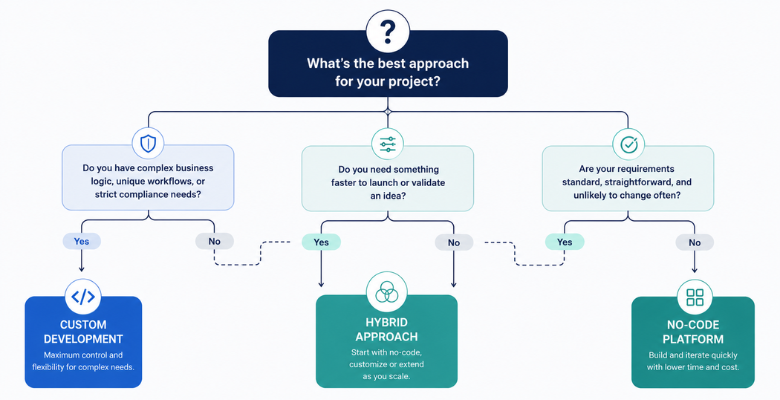
Use this framework to make the right choice for your specific situation:
-
Is your software the core product you are selling? → YES: Custom. NO: Continue.
-
Do you need to handle sensitive regulated data (healthcare, finance, legal)? → YES: Custom. NO: Continue.
-
Do you expect more than 10,000 active users within 12 months? → YES: Custom. NO: Continue.
-
Do you require integrations with proprietary or legacy enterprise systems? → YES: Custom. NO: Continue.
-
Is your budget under $30,000 and your goal to validate before investing further? → YES: No-Code. NO: Continue.
-
Are your requirements standard (forms, workflows, dashboards, CRM)? → YES: No-Code. NO: Custom.
If you answered NO to everything: You are in hybrid territory. Start with no-code for the standard components and build custom for the specialised ones.
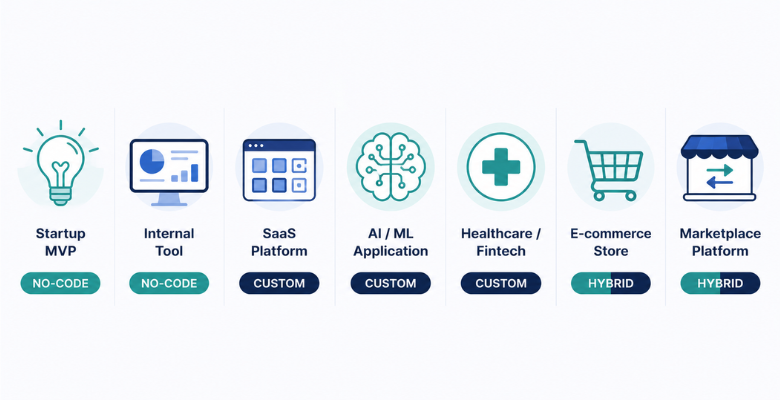
Real Cost Scenarios
| Project Type | Best Approach | Year 1 Cost | Risk if Wrong Choice |
|---|---|---|---|
| Startup MVP (unvalidated idea) | No-Code | $10,000–$25,000 | Wasting $80K+ on wrong product |
| Internal operations tool | No-Code | $5,000–$15,000 | Overpaying for custom when standard features suffice |
| SaaS platform (your product) | Custom | $60,000–$120,000 | Platform lock-in, rebuild cost at scale |
| AI/ML application | Custom | $80,000–$200,000 | No-code cannot support ML logic |
| Healthcare/Fintech app | Custom | $100,000–$250,000 | Compliance failure on third-party infrastructure |
| E-commerce store | No-Code | $3,000–$10,000 | Custom overkill for standard e-commerce |
| Complex marketplace platform | Hybrid | $40,000–$80,000 | Pure no-code breaks under marketplace complexity |
Frequently Asked Questions
Can no-code platforms really compete with custom development in 2026?
For standard business applications — yes. For performance-critical, compliance-heavy, or competitive-advantage software — no. The 2026 landscape is not ‘no-code vs custom.’ It is ‘right tool for the right stage.’
What happens when I outgrow a no-code platform?
You face three options: upgrade to higher-tier pricing (which can be significant at scale), migrate to custom code (typically costs 1.5–3x the original build), or rebuild from scratch. Plan for migration from day one. Set a trigger: when platform fees exceed 10% of monthly revenue, start the migration conversation.
Is it possible to build a professional-quality product on no-code?
Yes, for the right type of product. Bubble-built applications have served thousands of users and attracted venture funding. The question is not quality — it is ceiling. The ceiling is real and it will matter eventually for any growing business.
How has AI changed the no-code vs custom debate?
Significantly. AI-assisted development tools have compressed the time and cost of custom development to the point where for many projects in 2026, a skilled developer with AI tools can produce custom code in the same timeframe as a no-code build — but with full ownership and no platform ceiling. Get quotes from custom developers before assuming no-code is cheaper.
Which is better for SEO — a no-code or custom-built website?
Custom-built websites have more flexibility for technical SEO implementation. No-code platforms like Webflow are increasingly capable but still have limitations on Core Web Vitals, custom schema markup, and server-side rendering. For a business where organic search is a primary acquisition channel, custom or headless architecture gives you significantly more control.
Not Sure Which Approach Is Right for Your Project?
We’ve Built Both. We’ll Tell You Honestly Which One Fits.
We have built both — from no-code MVPs validated in 6 weeks to enterprise AI platforms with 50,000+ users. Book a 30-minute technical consultation and we will tell you honestly which approach fits your budget, your timeline, and your scale ambitions.
Not sure which approach is right for your project?
We've built both. We'll tell you honestly which one fits.
From no-code MVPs validated in 6 weeks to enterprise AI platforms with 50,000+ users, we've built across the whole range. Book a consultation and we'll tell you honestly which approach fits your budget, your timeline, and your scale ambitions.
Book a discovery call