MVP to Enterprise: Scaling SaaS Products 10x Faster with No-Code/AI Hybrids

Listen to this article
The conventional wisdom in tech says you need a full engineering team, months of development, and a hefty budget to build a serious SaaS product. I’m here to tell you that’s becoming increasingly outdated.
Over the past three years, I’ve watched founders bootstrap their way from idea to six-figure ARR using no-code platforms as their foundation, then strategically layer in custom code only where it matters. The results? Products that reach market in weeks instead of months, pivot costs measured in hours instead of sprints, and infrastructure bills that don’t require venture funding to sustain.
But here’s what nobody talks about: the transition phase. That messy middle ground where your Bubble app is handling real revenue, your Airtable automations are running mission-critical workflows, and you’re wondering if you should rebuild everything “properly” before it all falls apart.
This is the guide I wish I had when I was staring at that decision.
The Real Economics of No-Code at Scale
Let me start with some uncomfortable truths. No-code platforms weren’t designed to run Salesforce competitors. They have real limitations. But the math on getting to product-market fit is so overwhelmingly in their favor that ignoring them is leaving money on the table.
Consider the typical path: hire a technical co-founder or contract developers, spend three months building your MVP, launch to crickets, realize you built the wrong thing, spend another two months pivoting. You’re six months in, you’ve burned through $50k to $100k, and you still don’t know if anyone wants what you’re building.
Now consider the no-code path: spend two weeks in Bubble.io building your core workflow, launch to your first ten customers, get real feedback, rebuild the problematic parts in three days. You’re one month in, you’ve spent maybe $2k, including your subscription fees, and you have paying customers telling you exactly what needs to change.
The velocity difference isn’t just about speed. It’s about maintaining momentum when you’re wrong, which you will be, repeatedly.
Where No-Code Actually Breaks Down
I need to be honest about the failure modes because understanding them is what makes the hybrid approach work.
- Performance becomes unpredictable under load. Your Bubble app that handles 100 users just fine might crawl to a halt at 500. The database queries that seemed fast suddenly timeout. This isn’t because no-code is inherently slow but because you don’t control the optimization layer.
- Complex data operations hit walls quickly. Try running a recursive algorithm in Bubble or processing thousands of records in a single workflow. The platforms simply weren’t architected for computational complexity beyond basic CRUD operations and conditional logic.
- Third-party integrations multiply your dependencies. Every Zapier connection is another point of failure. Every API call through Make.com adds latency. When you’re stitching together six different services to accomplish one business process, you’ve created a house of cards.
- Pricing scales with usage, not efficiency. This is the big one. On traditional infrastructure, you can optimize your code and reduce costs. On no-code platforms, you’re paying per workflow run, per database row, per API call. There’s no way to optimize your way out of those bills at scale.
Here’s the thing, though. None of these problems matter until they matter. And when they start to matter, you’ll have revenue to solve them properly.

The Hybrid Architecture That Actually Works
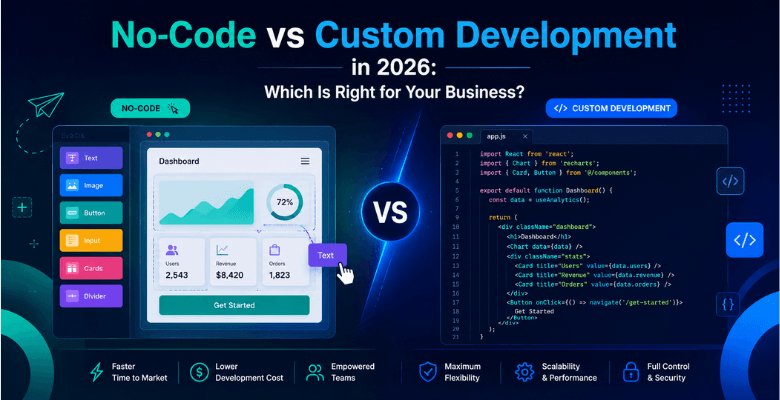
The mistake I see founders make is thinking it’s an all-or-nothing choice. Either you’re fully no-code, or you’re fully custom. The smart money is in the middle.
- Start with this mental model: no-code handles your application layer, custom code handles your data and computation layer. Let Bubble render your UI, manage your user authentication, and handle your payment flows. Build a robust backend API for any feature that involves significant data processing or requires independent scalability.
- In practice, this looks like Bubble as your frontend, authenticated via JWT tokens to a Node.js or Python backend running on Railway or Render. Your Bubble app makes API calls to your custom backend for anything complex: analytics calculations, batch operations, integrations with enterprise tools, AI/ML features.
The beautiful part? Your users never know the difference. They’re interacting with Bubble’s polished interface while you’re controlling the scalable pieces underneath.
Rapid Prototyping: The Actual Process
Let me walk you through how this works in reality, not theory.
You have an idea for a project management tool that uses AI to predict task delays. Day one, you open Bubble. You’re not building the AI yet. You’re building the boring stuff: user signup, project creation, task lists, team collaboration. This process takes approximately a week if you’re new to Bubble, and three days if you’ve completed it before.
Day eight, you’ve got something demo-able. You show it to five potential customers. Three of them say the UI for assigning tasks is confusing. You rebuild that section in two hours. By day ten, you have a clearer picture of what they actually need.
Now you need to add that AI prediction feature. This is where you shift gears. You spin up a FastAPI backend, integrate OpenAI’s API or train a simple model if you have the data, expose it as an endpoint. Your Bubble app sends task data to this endpoint, gets back predictions, displays them to users. You built the AI piece in custom code because trying to do it in Bubble would be painful and expensive. But you didn’t rebuild your entire app.
Two weeks in, you have a functional product with a genuinely sophisticated feature. You didn’t compromise on capability, you just picked your battles.
The Custom Backend Decision Tree
How do you know when something needs to move to custom code? I use these triggers.
- Move it if performance is measurably degrading. Not “feels slow sometimes” but “query times are averaging over 2 seconds.” Measure first, then decide. A lot of perceived slowness in no-code apps is actually bad database design or overly complex workflows that could be simplified without leaving the platform.
- Move it if you’re processing over 10,000 records regularly. Bulk operations in no-code platforms are expensive and fragile. If you’re running nightly jobs that touch your entire user base, that belongs in custom code with proper database optimization.
- Move it if the logic is complex enough that you’re fighting the platform. When you find yourself using recursive workflows, deeply nested conditionals, or multiple database calls just to calculate one value, that’s a sign. The code is trying to tell you it wants to live somewhere else.
- Move it if the cost is material relative to revenue. If you’re spending $500/month on workflow runs and making $2,000/month, maybe that’s fine. If you’re spending $5,000/month on workflow runs and making $8,000/month, you have a problem that custom code solves immediately.
- Don’t move it if it changes frequently based on user feedback. This is the crucial one. If you’re still figuring out the feature, keep it in no-code where you can iterate daily. Premature optimization to custom code locks you into decisions before you have enough information to make them.

Low-Code Automation That Doesn’t Break
Let’s talk about the glue layer. The automations between systems. This is where things get messy fast if you’re not careful.
The temptation is to use Zapier or Make.com for everything. Don’t do this. Those platforms are fantastic for simple automations: new Stripe payment creates a row in Google Sheets, new form submission sends a Slack message. They fall apart when you need reliability.
If an automation failing means a customer doesn’t get their invoice or a critical notification doesn’t send, that automation needs to be in code. Build a proper job queue using something like BullMQ or Celery, with retry logic and error monitoring. Yes, this requires actual development. That’s the point. The consequences of failure dictate the tool.
For non-critical automations, go wild with the low-code tools. They’re perfect for internal workflows, reporting, data syncing that you can manually fix if it breaks. Just be honest about what category each automation falls into.
Scaling Startup Infrastructure Without Venture Capital
One of the biggest myths in startup land is that you need serious funding to scale infrastructure. You don’t. You need to be smart about where you spend money.
A hybrid architecture lets you scale the expensive parts (computation, database operations, API calls) independently from the cheap parts (UI rendering, simple workflows). Your Bubble app stays on their $300/month plan because it’s just showing data and collecting user input. Your custom backend scales up and down based on actual load because you’re on Render’s autoscaling tier.
The infrastructure spend that makes sense looks like this: Bubble for frontend ($300/month), Render or Railway for backend ($50-500/month depending on load), Supabase or PlanetScale for your primary database ($25-100/month), Cloudflare for CDN and DDoS protection (free to $20/month), Sentry for error monitoring ($25/month).
We’re talking $400 to $1,000 per month to run a product serving thousands of users. Compare that to the traditional path where AWS bills alone can hit $2,000/month before you’ve optimized anything.
The key is incremental scaling. You don’t build for a million users on day one. You build for your first hundred users, then refactor the slow parts when you hit a thousand, then optimize the database when you hit ten thousand. Each phase of growth funds the next phase of infrastructure investment.
Bubble.io for Enterprise: Yes, Really
I know what you’re thinking. Bubble for enterprise sounds like an oxymoron. But I’ve seen it work, with some important caveats.
- Enterprise customers care about three things: security, reliability, and compliance. Bubble actually handles the first one reasonably well out of the box. They’re SOC 2 compliant, they support SSO, they have reasonable data residency options. If your enterprise customer has standard security requirements, Bubble can often meet them.
- Reliability is where you need the hybrid approach. Your Bubble app talks to a custom backend that you control, where you can implement proper monitoring, logging, and failover. The enterprise customer never hits Bubble directly for anything mission-critical. They’re hitting your infrastructure, which happens to have a Bubble frontend.
- Compliance is case by case. If you’re in healthcare and need HIPAA compliance, you’ll need a custom backend that’s properly architected for it. Bubble can still be your UI layer, but the data lives in your HIPAA-compliant infrastructure. If you’re in fintech, same deal with SOC 2 Type II or whatever your regulators require.
- The controversial take: I’ve seen Bubble apps serving Fortune 500 companies. They work because the team was strategic about what lived in Bubble (UI, workflow orchestration, user management) and what lived in custom infrastructure (data processing, integrations, anything the enterprise customer audits).

The Migration Path Nobody Talks About
Eventually, you might decide to move off no-code entirely. Maybe you’ve raised a Series A and have a proper engineering team. Maybe your Bubble bills are genuinely approaching the cost of custom development. Maybe you just want full control.
Here’s how you do it without destroying your business.
- First, stop adding new features to Bubble immediately. Feature freeze. Everything new goes into your custom stack. This prevents the Bubble app from becoming more entrenched.
- Second, identify the highest-value pages and workflows. The ones your most important customers use daily. Rebuild those first in your custom frontend. Keep both versions running in parallel, gradually shifting users over with feature flags.
- Third, migrate your data model intelligently. Export everything from Bubble’s database into your new database, but keep Bubble as the system of record temporarily. Write sync scripts that keep both databases aligned. Only cut over fully once you’ve verified everything matches.
- Fourth, maintain API compatibility. Your custom backend should expose identical endpoints to what Bubble was consuming. This lets you swap out the backend without touching the Bubble frontend if needed.
- The migration takes months, not weeks. Budget for it accordingly. And be prepared for the possibility that you might keep parts of Bubble forever. If there’s a rarely-used admin panel that works fine and generates no complaints, maybe leaving it in Bubble is the right call.
What This Looks Like in Practice: Real Numbers
Let me give you actual numbers from a SaaS product I advise. They started in Bubble, moved to a hybrid architecture at around $15k MRR, and are now at $80k MRR with the same basic technical approach.
- Month 1-3: Pure Bubble. Infrastructure cost: $200/month. Team size: one founder. Revenue: $0.
- Month 4-8: Hybrid architecture emerges. Built a custom Python backend for their core data processing. Infrastructure cost: $450/month. Team size: one founder, one part-time developer. Revenue: $5k to $15k MRR.
- Month 9-18: Refining the hybrid. Added more custom services, kept Bubble for the main app and several admin tools. Infrastructure cost: $800/month. Team size: one founder, one full-time developer, one part-time developer. Revenue: $15k to $50k MRR.
- Month 19-24: Current state. Bubble still handles user-facing app and workflow automation. Custom backend handles all data processing, integrations, analytics. Infrastructure cost: $1,200/month. Team size: one founder, two full-time developers. Revenue: $60k to $80k MRR.
The important part isn’t the exact numbers. It’s the ratio. Their infrastructure cost as a percentage of revenue went from undefined (no revenue) to 3% to 1.5% to 1.5%. They maintained profitability the entire way while scaling 16x in 18 months.
The Uncomfortable Truth About Technical Debt
Every no-code implementation accumulates technical debt differently than traditional code. You can’t refactor a Bubble workflow the way you refactor a JavaScript function. You can’t write unit tests for Make.com automations. The debt is real and it compounds.
But here’s what I’ve learned: technical debt only matters if it prevents you from moving forward. If you can still ship features, still onboard customers, still fix bugs in reasonable time, the debt is manageable. The moment it starts blocking you, that’s when you address it.
I’ve seen founders rewrite their entire stack because they hated looking at their “messy” Bubble app, even though it was making them $30k/month. That’s ego, not engineering. I’ve also seen founders ignore obvious problems until their app became unusable. That’s negligence.
The skill is distinguishing between debt that’s slowing you down and debt that’s just aesthetically displeasing to engineers. Most technical debt falls into the second category. Fix the first kind ruthlessly. Ignore the second kind until it matters.
Why This Approach Wins
The no-code to hybrid path works because it aligns your technical decisions with your business reality. You move fast when you need speed. You build properly when you need scale. You spend money on infrastructure when you have money from customers.
Compare this to the traditional path where you make all your technical decisions up front, when you have the least information about what you’re building and the least money to build it with. You’re optimizing for theoretical scale while your actual problem is finding ten people who care about your product enough to pay for it.
The hybrid approach lets you be right at each stage. Right for prototyping (no-code), right for early traction (mostly no-code with custom elements), right for scaling (strategic custom code with no-code support), right for enterprise (fully custom where it matters, no-code where it doesn’t).
You’re not building for where you might be in three years. You’re building for where you are today, with a path to where you need to be tomorrow.

The Tactical Playbook
If you’re starting from scratch today, here’s exactly what I’d do.
- Week 1-2: Build your entire MVP in Bubble or another no-code platform. Don’t write a single line of custom code. Get something in front of users as fast as possible. If you can’t build your core idea in no-code, your core idea is probably too complex and needs to be simplified anyway.
- Week 3-6: Launch to your first 20 users. Iterate based on their feedback. Still no custom code unless something is genuinely impossible in no-code. Most things that feel impossible are actually just difficult, and difficult is fine at this stage.
- Week 7-12: If you have paying customers and one or two features that are clearly straining the no-code platform, build a custom backend API for just those features. Keep everything else in no-code. Set up proper error monitoring and logging for your custom pieces.
- Month 4-6: You should have some signal on product-market fit by now. If you don’t, keep iterating in no-code. If you do, identify your next three bottlenecks. Move one or two to custom code. Leave the rest in no-code.
- Month 6+: You’re in optimization mode. Custom backend handles data-intensive operations, complex business logic, and anything that needs to scale independently. No-code handles UI, simple workflows, and features that change frequently. You rebuild pieces as they become expensive or slow, not before.
At each stage, you’re solving the actual problems you have, not the problems you think you might have later. This is how you build a real business instead of a theoretical one.
What Nobody Tells You
The hardest part of the hybrid approach isn’t technical. It’s psychological. You’ll have developers tell you it’s hacky. You’ll have investors question whether it can scale. You’ll have advisors suggest you rebuild everything properly before it’s too late.
Ignore them unless they’re writing the checks or building the product. The only opinion that matters is whether your approach lets you serve customers effectively and grow sustainably. Everything else is noise.
The second hardest part is hiring. Developers often want to work on “real” tech stacks, not Bubble apps. You’ll need to find people who care more about solving problems than polishing their resume. They exist, but they’re rarer.
The third hardest part is resisting the urge to rebuild too early. You’ll be tempted to rewrite everything in proper code the moment you can afford it. Don’t. Rewrite only what’s blocking you. Keep the no-code pieces that work. You’ll move faster and waste less money.
The Path Forward
- The future of SaaS development isn’t fully custom or fully no-code. It’s hybrid. It’s strategic. It’s about using the right tool for each specific problem instead of picking one approach and forcing everything through it.
- The founders who win in the next few years will be the ones who embrace this reality. Who can move from idea to revenue in weeks. Who can pivot without burning months of development time. Who can scale intelligently instead of prematurely.
- No-code gave us speed. Custom code gives us power. The hybrid approach gives us both, exactly when we need each one.
The question isn’t whether you can build a serious SaaS product this way. The question is whether you can afford not to.
Ready to Move Beyond the "No-Code Wall"?
Building an MVP is easy; scaling it into a sustainable enterprise is where the real work begins. If your Bubble app is hitting performance limits, or you’re ready to layer in custom AI features that no-code can’t handle, let’s talk.
At Ellocent Labs, we specialize in the "Hybrid Shift"—keeping your frontend agile while building the robust, custom backend your growth requires.
Not sure which approach is right for your project?
We've built both. We'll tell you honestly which one fits.
From no-code MVPs validated in 6 weeks to enterprise AI platforms with 50,000+ users, we've built across the whole range. Book a consultation and we'll tell you honestly which approach fits your budget, your timeline, and your scale ambitions.
Book a discovery call