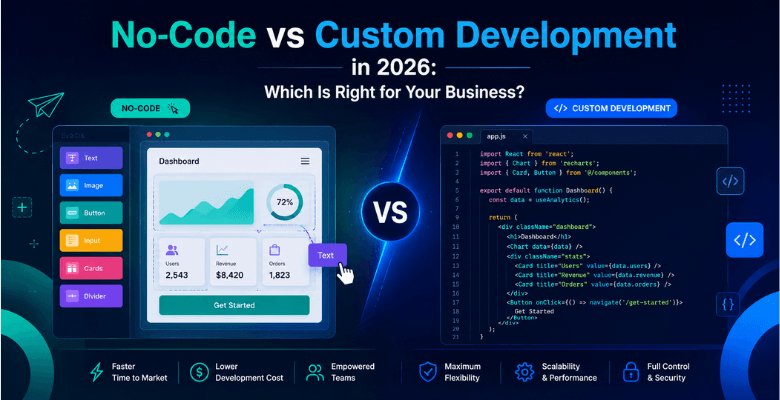
Low-Code vs Traditional Development: Complete Cost-Benefit Analysis for 2026

Listen to this article
Introduction
The software industry is evolving at lightning speed. With businesses under constant pressure to innovate, choosing the right development approach is more important than ever. By 2026, organizations face two distinct paths: Low-Code Development, which promises speed and agility, or Traditional Development, which provides full customization and control.
Both approaches have strengths and trade-offs. In this blog, we’ll provide a complete cost-benefit analysis, explore real-world use cases, and outline where each approach fits best in 2026.
Understanding the Two Approaches
What is Low-Code Development?
Low-code platforms allow developers (and even non-developers) to build applications using drag-and-drop interfaces, pre-built components, and minimal coding. These platforms reduce the reliance on deep programming expertise and speed up delivery.
Key Features of Low-Code:
- Visual app builders with reusable components
- Pre-built connectors for databases and APIs
- Built-in security, hosting, and monitoring by the vendor
- Subscription-based licensing models
Popular Platforms: Bubble, Draftbit, Webflow and so on
What is Traditional Development?
Traditional development involves building software from scratch using programming languages such as Java, Python, and JavaScript. This approach offers maximum flexibility and scalability but comes with longer timelines and higher costs.
Key Features of Traditional Development:
- Full control over system architecture and integrations
- Unlimited customisation possibilities
- Greater scalability and performance optimisation
- Requires skilled developers and larger teams
Popular Tech Stacks: Python, Java, JavaScript, Typescript and so on

Cost-Benefit Analysis (2026 Outlook)
Here’s a breakdown of how Low-Code and Traditional Development compare:
1. Development Speed
Low-Code: Cuts delivery time by 60–70%. An MVP can be built in weeks instead of months.
Traditional: Slower due to manual coding, testing, and deployment cycles.
? Example: An e-commerce launching app can go live in 4 weeks with low-code vs 2-4 months with traditional development.
2. Cost & Resource Efficiency
Low-Code: Lower upfront costs, fewer developers required, but recurring subscription fees (ranging from $25/user/month to enterprise-level six-figure contracts).
Traditional: Higher upfront development cost, larger team, but no vendor lock-in or recurring licensing fees - especially when built using scalable custom software development approaches.
? Example:
A CRM built on low-code could cost $10K upfront + $2K/month subscription.
The same CRM via traditional dev might cost $20 upfront, but minimal recurring costs.
3. Customisation & Flexibility
Low-Code: Customisation limited to platform features. Adding unique features often requires expensive add-ons or external integrations.
Traditional: Infinite customization—best for unique industry needs or complex workflows.
? Example: A healthcare app requiring HIPAA-compliant video consultations and custom EHR integrations would be difficult to build entirely on low-code but possible with traditional dev.
4. Scalability & Performance
Low-Code: Great for small-to-mid scale apps (1,000–50,000 users). May struggle with millions of concurrent users. Vendor scaling costs can skyrocket.
Traditional: Scales to any level with the right architecture (microservices, cloud-native, Kubernetes).
? Example: A financial institution handling millions of daily transactions would require traditional development to ensure stability.
5. Security & Compliance
Low-Code: Security handled by the platform vendor. Limited customization for compliance-heavy industries (finance, healthcare, government).
Traditional: Complete control over security protocols, data storage, and compliance frameworks like SOC-2, HIPAA, or GDPR.
? Example: A fintech platform with custom fraud detection algorithms must use traditional dev for regulatory compliance.
6. Maintenance & Updates
Low-Code: Vendor handles platform updates, patches, and hosting. Risk of vendor lock-in—if the vendor changes pricing or policies, businesses have little control.
Traditional: Requires dedicated dev/ops teams but offers long-term independence and flexibility, especially when paired with reliable cloud computing services.
? Example: If a low-code vendor discontinues support, migrating to another platform can cost 2–3x more than the original investment.
Where Low-Code Wins in 2026
- MVPs & Prototypes – validate ideas quickly
- Internal Business Tools – HR, payroll, CRM, workflow automation
- Startups & SMEs – save cost, reduce time-to-market
- Citizen Development – empower non-technical teams to build apps

Where Traditional Development Wins in 2026
- Enterprise-Grade Applications – banking, healthcare, large-scale SaaS
- High Security Needs – fintech, government, defence
- Complex Integrations – legacy systems, IoT, multi-cloud ecosystems
- High Scalability – apps with millions of concurrent users
Hybrid Approach: Best of Both Worlds
In 2026, many organizations adopt a hybrid model:
- Use Low-Code for front-end workflows and rapid prototyping
- Use Traditional Development for core business logic and scalability
? Example: A logistics company might use a low-code platform to build an internal dashboard for dispatchers but rely on traditional development for its real-time route optimization engine.

Decision-Making Framework: Low-Code vs Traditional
Ask These Questions Before Choosing:
- What’s your budget and timeline?
- Is the app mission-critical or just for internal use?
- How many users do you expect in 3–5 years?
- Do you need regulatory compliance (HIPAA, GDPR, PCI-DSS)?
- Is long-term customization more important than short-term speed?
✅ If speed + cost efficiency matter most → Choose Low-Code.
✅ If security, scale, and uniqueness matter most → Choose Traditional Development.
Conclusion
By 2026, Low-Code platforms will power rapid business applications, empowering startups and SMEs to innovate faster. But for complex, secure, and scalable enterprise systems, Traditional Development remains unmatched.
The smartest organizations won’t choose one over the other—they’ll combine both to balance agility with long-term stability.
? Looking to decide whether low-code ot traditional development fits your project in 2026? Hire our development team to help you evaluate costs, scalability, and compliance and find the best-fit solution for your business.
Not sure which approach is right for your project?
We've built both. We'll tell you honestly which one fits.
From no-code MVPs validated in 6 weeks to enterprise AI platforms with 50,000+ users, we've built across the whole range. Book a consultation and we'll tell you honestly which approach fits your budget, your timeline, and your scale ambitions.
Book a discovery call