AI in Mining: What Perth Operators Do Differently
Listen to this article
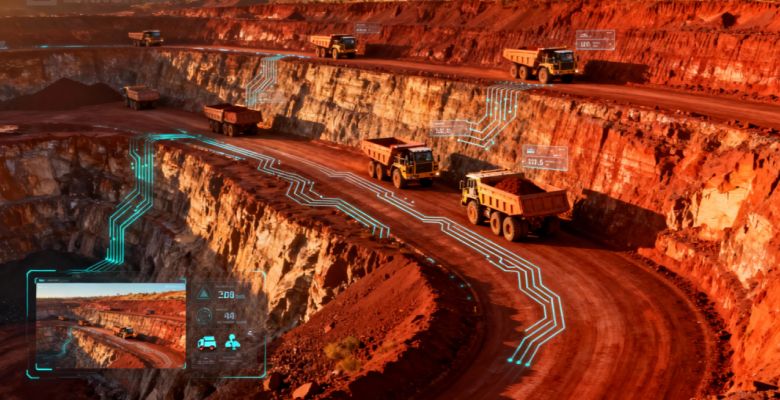
Western Australia's large iron ore miners run much of their Pilbara operations from remote operations centres in Perth, more than 1,000 km away, using autonomous haul trucks, driverless rail and integrated data across pit, plant and port. That model is why Perth is one of the world's leading places for industrial AI. For mid-tier miners, the useful lesson is not to copy a billion-dollar programme but to connect the data they already have and automate one high-value decision at a time.
The Perth model: remote operations
Rio Tinto opened its Perth operations centre in 2010, and BHP and Fortescue have since built their own integrated operations centres in the city. Controllers there plan and monitor mines, rail and ports across the Pilbara from one place. Three things make this model work:
- Autonomy in the field: autonomous haulage systems for trucks and drills, and Rio Tinto's AutoHaul driverless trains, generate a constant stream of operating data.
- One view of the value chain: pit, processing, rail and port data feed shared planning tools, so a delay at one point changes the plan at the others.
- Specialists in one location: engineers and analysts work from the city, supporting several sites without fly-in fly-out rosters.
Where AI is used in Australian mining today
Autonomous haulage and drilling
Autonomous trucks follow planned routes and adjust to traffic and conditions, with people supervising remotely. The benefits most often cited are safety (fewer people near heavy equipment) and consistency.
Predictive maintenance
Sensors on trucks, conveyors, crushers and mills feed models that predict failures before they happen. The step beyond prediction is prescriptive maintenance: the system checks spare-part stock and maintenance rosters, and recommends when to intervene.
Processing optimisation
Models adjust crusher and mill settings to ore hardness and feed rates to improve throughput and energy use.
Safety monitoring
Proximity detection, geofenced exclusion zones around autonomous equipment and computer vision on existing cameras (for example, detecting people in restricted areas or missing PPE) help prevent incidents. Fatigue monitoring in vehicles is widely used, typically through in-cab systems.
Geology and planning
Machine learning helps interpret drilling and assay data and supports mine planning. Spatial data platforms (GIS) bring geology, assets and logistics onto one map.
Energy and emissions
As sites add solar, batteries and electrified equipment, software that schedules energy use and tracks emissions per tonne is becoming part of everyday operations.
The mid-tier challenge
Lithium, gold and critical-minerals miners face the same pressures as the majors with far smaller technology budgets. Common obstacles:
- Data spread across fleet systems, maintenance software, ERP and spreadsheets that do not talk to each other.
- Off-the-shelf products that do not fit their particular processes or geology.
- Small technical teams who cannot run large data platforms.
Practical first AI projects for mid-tier miners
| Project | What it does | Data needed |
|---|---|---|
| Maintenance prediction for one asset class | Flags likely failures on, say, conveyors or pumps before they stop production | Sensor history and maintenance records |
| Roster and shift-fill automation | Matches qualified people to open shifts and chases confirmations | Roster, qualifications and leave data |
| Processing bottleneck analysis | Finds where the circuit loses throughput using existing plant data | Plant historian data |
| Camera-based safety alerts | Uses existing CCTV to detect people in exclusion zones | Camera feeds and site zone maps |
| Integrated operations dashboard | One view of fleet, plant and stockpile data | Exports or APIs from current systems |
The pattern is the same each time: connect the data that exists, automate one decision, measure the result, then expand. A small integration layer between existing systems often unlocks more value than a new platform.
What to get right before you start
- Data access: confirm you can extract data from fleet, plant and maintenance systems, and who owns it.
- Connectivity: remote sites need a plan for limited bandwidth, including processing at the edge where needed.
- Safety approval: any system that influences operations needs your site's safety and change-management sign-off.
- A clear measure: downtime hours, tonnes per hour or shifts filled, with today's baseline.
How Ellocent Labs can help
We are a software engineering company, not a mining company. We build the software layer between systems: data integration, predictive models, GIS and mobile apps that let supervisors review and approve recommendations. Our team is based in India and works with Australian clients remotely, with agreed overlap hours for workshops and reviews.
Frequently asked questions
How is AI used in mining in Australia?
For autonomous haulage and rail, predictive maintenance, processing optimisation, safety monitoring, geology and planning, and energy management, often coordinated from remote operations centres in Perth.
Why is Perth a centre for mining AI?
Because the largest Pilbara operators run their mines, rail and ports from integrated operations centres in Perth, creating a concentration of automation and data expertise.
Can smaller miners afford AI?
Yes, if they start small: one asset class or one decision, using data they already collect, before scaling up.
What is a remote operations centre?
A control room, usually in a city, from which staff plan and monitor remote mine sites, rail and ports in real time.
Talk to us about a first project
Book a discovery call to discuss which decision in your operation is worth automating first.
Not sure which approach is right for your project?
We've built both. We'll tell you honestly which one fits.
From no-code MVPs validated in 6 weeks to enterprise AI platforms with 50,000+ users, we've built across the whole range. Book a consultation and we'll tell you honestly which approach fits your budget, your timeline, and your scale ambitions.
Book a discovery call