AI Agents vs AI Automation: What's the Difference, and Which Does Your Business Need?
Listen to this article
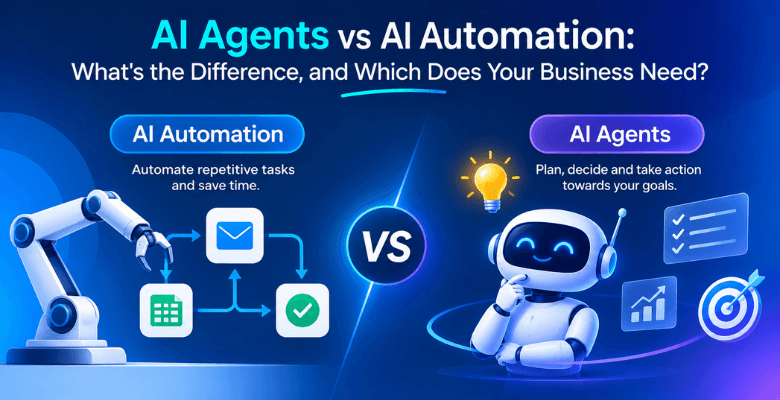
AI automation follows steps that people define, with an AI step such as reading or drafting inside them. An AI agent is given a goal and chooses its own steps and tools. Use automation when the path is known, use an agent only when the path genuinely varies, and keep a person in front of anything that cannot be undone.
The two terms are often used as if they mean the same thing. They do not, and choosing the wrong one is an expensive way to find out. This guide explains the difference in plain terms, compares the options side by side, and shows how we mix them in a real system.
Is an AI agent the same as automation?
No, although one contains the other. Automation is the broad idea: software does a job that a person used to do. An AI agent is one kind of automation, the kind where the software decides what to do next. In ordinary automation a person decides the steps in advance and the software repeats them.
Is AI a type of automation? In the sense that AI can do work people used to do, yes. But not all automation uses AI, and a great deal of useful business automation still does not.
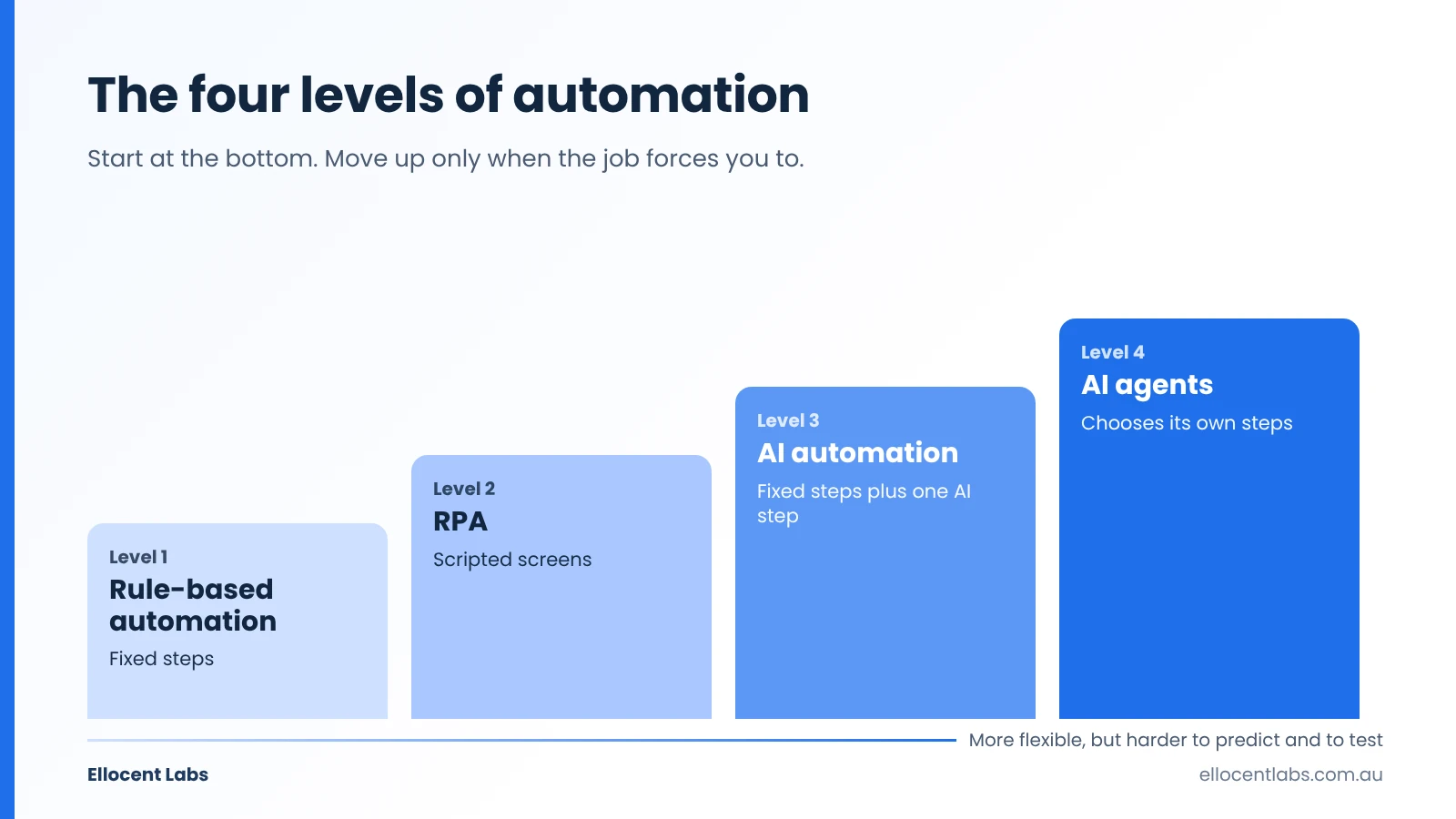
What are the four levels of automation?
- Rule-based automation. If this, then that. The same input always gives the same output. Examples: send an invoice reminder five days after the due date, or sync a record between two systems every night.
- RPA (robotic process automation). Software that operates other applications by clicking and typing like a person, used when there is no proper integration to call. It follows a script, so it breaks when a screen changes.
- AI automation. A fixed workflow with an AI step inside it: classify an incoming email, pull the fields out of a PDF, or draft a reply. People set the path, and the AI handles one messy step.
- AI agents. Given a goal and a set of tools, the agent chooses the steps, calls the tools, checks the results and tries again. The path is not fixed in advance.
Each level up handles messier work, and each is harder to predict and to test.
Is an AI agent just a bot?
A bot, such as a basic chatbot, follows a script or answers questions. It talks. An agent acts: it can look things up, call other systems and make several moves in a row toward a goal. The line is blurry, because many products called bots now do a bit of both. The useful test is who decides the next step, a script or the software.
Is ChatGPT an AI agent or just an LLM?
ChatGPT is a product built on a large language model (LLM). The model produces text. A plain chat is not an agent, because it answers and stops. A model becomes part of an agent when it is given tools, such as search, files or other systems, and permission to take several steps toward a goal without being asked each time. Some products now offer that mode, so the honest answer is "sometimes, depending on how it is set up".
What are the types of AI agents?
Textbooks usually list five: simple reflex, model-based reflex, goal-based, utility-based and learning agents. Web lists often reach seven by adding hierarchical and multi-agent systems. The count differs by source, so treat it as a teaching aid. For a business decision, a different question matters more: how much freedom does the agent have, and what can it change without a person looking?
How do AI agents, AI automation and RPA compare?
| Rule-based | RPA | AI automation | AI agent | |
|---|---|---|---|---|
| Who decides the steps | A person, in advance | A person, in advance | A person, in advance | The software, as it goes |
| Handles messy input | No | No | Yes, in the AI step | Yes |
| Predictable output | High | High, until a screen changes | Medium | Lower |
| Typical failure | Misses a case nobody planned | Breaks when the interface changes | Misreads one input | Takes a wrong turn several steps in |
| Testing | Straightforward | Straightforward but fragile | Test the AI step with examples | Hardest: you test paths, not just answers |
| Human review | Rarely needed | Rarely needed | On the AI step's output | On any action that cannot be undone |
Which one does your business need?
Start at the bottom of the ladder and move up only when the job forces you to.
- Is the path always the same? Use rule-based automation. It is cheaper, faster and easier to test than anything involving AI.
- Is there no integration, only a screen? RPA can bridge the gap, but treat it as a stopgap.
- Is the path fixed but the input messy? Use AI automation. Documents, emails and free-text forms are the usual cases.
- Does the path itself change depending on what the software finds? Only then consider an agent, and give it the narrowest permissions that work.
Avoid an agent when a mistake is costly and cannot be undone, when you need to explain every step to an auditor, or when a simple rule would do. Those are the cases where an agent's flexibility is a liability. For where agents are paying off and where projects stall, see our guide to AI agents in enterprise workflows.
What does a mix look like in practice?
Our investor relations platform for ASX-listed companies is mostly plain automation. About twenty scheduled jobs run on a dedicated worker, for example a nightly register sync, share prices every 15 minutes during market hours, and email dispatch every minute. None of that needs AI, so none of it uses AI.
AI appears only where judgement is needed. It drafts announcement summaries, social copy and answers to investor questions, grounded in that company's own announcement history. Every draft lands in a review queue, and a person has to approve it before anything is published. Publishing is explicit, and the approval is recorded where the application cannot edit it.
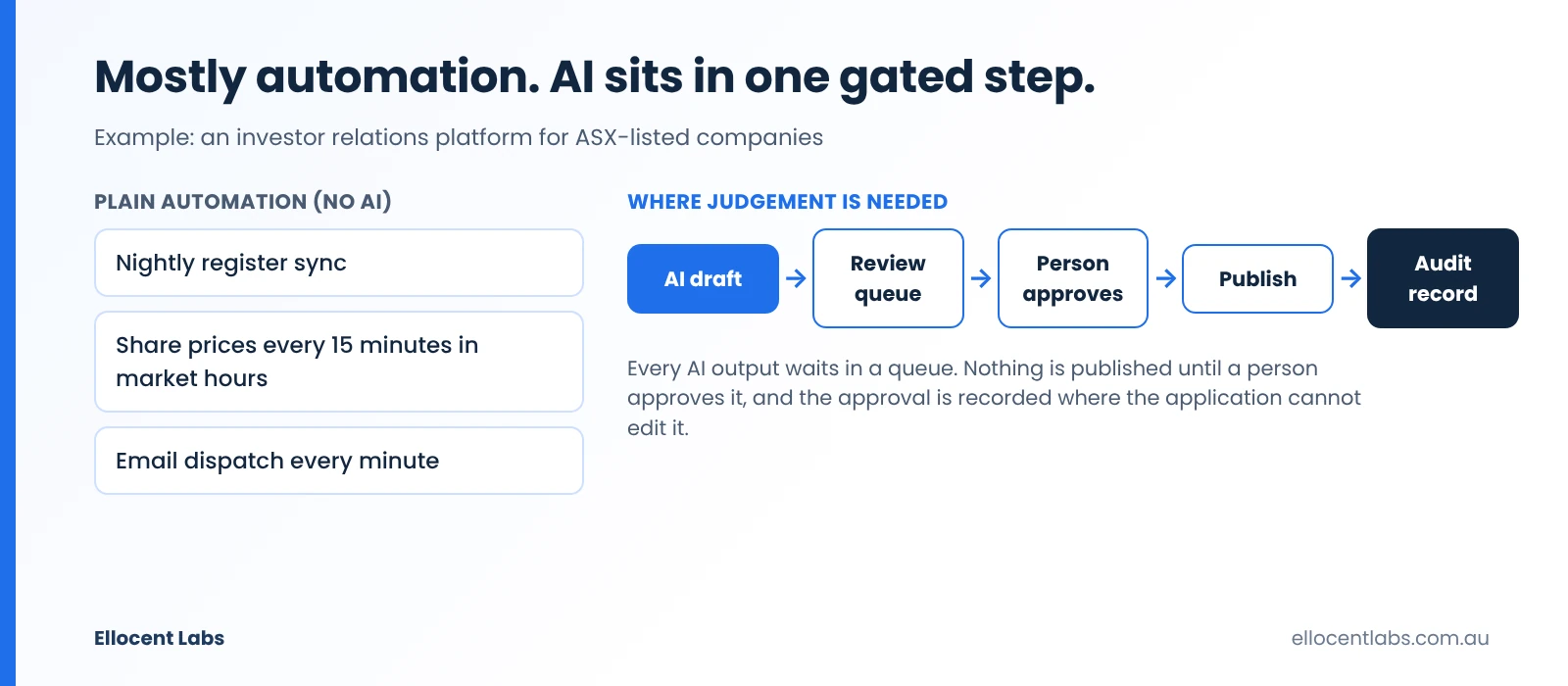
So most of the system is automation, and the AI sits in one gated step. The same attitude runs through how we build software generally: a person reviews what AI produces. Our engineering practices page sets out the rules, and the ASX investor relations guide explains the design in more detail.
Do Australian privacy rules affect the choice?
From 10 December 2026, organisations covered by the Australian Privacy Principles must say in their privacy policy when a computer program makes, or does something substantially and directly related to making, a decision that could reasonably be expected to significantly affect a person's rights or interests, using that person's personal information. The OAIC describes this as a "computer program", not AI specifically, so do not assume a rule-based system sits outside it.
The OAIC published a fact sheet and flowchart on 30 September 2026, and they are the place to start. This is general information, not legal advice, so check your own position with counsel.
Frequently asked questions
What is the difference between an AI agent and AI automation?
AI automation follows steps that people set in advance, with an AI step such as reading or drafting inside them. An AI agent is given a goal and chooses its own steps and tools.
Is an AI agent the same as automation?
No. An AI agent is one kind of automation, the kind where the software chooses its own next steps. Most business automation follows steps a person defined in advance.
Is ChatGPT an AI agent or an LLM?
ChatGPT is a product built on a large language model. A plain chat is not an agent. It becomes part of an agent when it is given tools and permission to take several steps toward a goal.
Is an AI agent just a chatbot?
No. A chatbot answers questions. An agent can also take actions, such as looking things up and calling other systems, in a series of steps.
Can AI agents replace RPA?
Sometimes. For stable, predictable tasks, plain automation or RPA is cheaper and easier to test. Agents suit work where screens, documents or steps vary from case to case.
Should a small business use an AI agent or simple automation?
Start with simple automation. Add an AI step where the input is messy, such as emails or documents. Consider an agent only if the steps genuinely change from case to case.
Do AI agents need human review?
Yes, for anything that cannot be undone or that affects people. Put the review in front of the action, not after it.
Not sure which one your process needs?
Tell us what the process looks like today and we will say whether plain automation is enough, which is often the answer. You can book a discovery call or email business@ellocentlabs.com.au. To see what we build, read about our AI development services.
Not sure which approach is right for your project?
We've built both. We'll tell you honestly which one fits.
From no-code MVPs validated in 6 weeks to enterprise AI platforms with 50,000+ users, we've built across the whole range. Book a consultation and we'll tell you honestly which approach fits your budget, your timeline, and your scale ambitions.
Book a discovery call