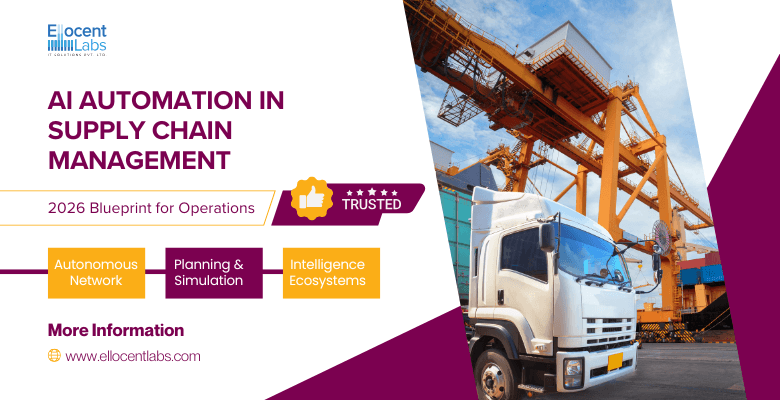
AI Automation in Supply Chain Management: 2026 Blueprint for Operations
Listen to this article
Discover how AI automation will create self-healing supply chains in 2026. Learn about cognitive logistics, autonomous planning, and how Ellocent Labs builds future-proof solutions.
Introduction: The Dawn of Autonomous Supply Chains
In 2026, supply chain complexity has reached an inflection point. With 73% of enterprises managing distributed multi-cloud operations across 15+ systems, traditional optimization methods are no longer sufficient. The scale of modern AI supply chain operations has outgrown human-led decision-making, with logistics networks generating millions of data points every hour.
This shift is not incremental—it’s evolutionary. Logistics automation has advanced beyond basic predictive analytics into cognitive, self-adaptive operations. This supply chain 2026 blueprint outlines how organizations can build intelligent supply chains that don’t just forecast disruptions, but autonomously reconfigure to sustain optimal flow—delivering 40–60% gains in operational resilience while cutting planning overhead by up to 80%.
The 2026 Framework: From Predictive to Cognitive Operations
The most significant shift since 2024 has been the transition from systems that assist human decision-makers to systems that own entire operational domains. The 2026 cognitive framework operates on three planes simultaneously.
1. Autonomous Network Orchestration
Modern supply chains no longer follow linear paths but exist as dynamic multi-dimensional networks. AI systems now continuously evaluate 47+ variables per transaction—including real-time carbon costs, supplier ESG scores, and geopolitical risk indices—to autonomously route goods through the optimal network path. These systems make thousands of micro-decisions daily without human intervention, creating what Gartner terms "self-healing supply networks."
2. Generative Planning & Simulation
The breakthrough of GenAI in supply chain planning has been transformative. Instead of analysts running scenarios, generative AI systems now create and evaluate millions of potential futures in simulation environments. Our teams at Ellocent Labs build custom AI solutions that leverage quantum-inspired algorithms to model entire global networks, identifying optimal configurations for everything from routine operations to black swan events.
3. Embedded Intelligence Ecosystems
AI is no longer a separate "system"—it's embedded in every component. From smart containers that negotiate their own last-mile delivery slots to warehouse robots that dynamically reorganize storage patterns based on predicted demand, intelligence is distributed. This requires a fundamentally different architectural approach, which we specialize in through our enterprise IoT integration practice.

The 2026 Tech Stack: Quantum Computing, Neuromorphic Chips, and Digital Twins
The underlying technology enabling this transformation has advanced dramatically:
- Quantum-Inspired Optimization: While full-scale quantum computing remains in development, quantum-inspired algorithms running on specialized hardware are solving previously intractable optimization problems. Route optimization that once took hours now occurs in milliseconds, evaluating factors from weather disruptions to port congestion in real-time.
- Neuromorphic Processing: For real-time decision-making at the edge, neuromorphic chips—which mimic the brain's neural structure—process sensor data with 1,000x greater energy efficiency than traditional chips. This enables truly autonomous decision-making in remote locations without cloud dependency.
- Living Digital Twins: The digital twin has evolved from a static model to a living system that continuously learns from its physical counterpart. Our recent supply chain digital twin implementation for a pharmaceutical client reduced clinical trial logistics costs by 34% by simulating and optimizing the entire cold chain network before physical deployment.
- Blockchain + AI Integration: Smart contracts have matured into cognitive contracts that automatically adjust terms based on AI-analyzed performance data. This creates self-governing partnerships where incentives automatically align with outcomes. Explore our work in enterprise blockchain solutions that make this possible.
The 2026 Business Impact: Metrics That Matter
The organizations that embraced AI automation early are now seeing compound returns:
- 47% Reduction in End-to-End Cycle Times: Autonomous systems compress planning, execution, and adjustment cycles from weeks to hours.
- $8.3M Average Annual Savings per $1B in revenue through waste elimination and capital optimization.
- 99.7% Forecast Accuracy at the SKU-location level, transforming inventory from a cost center to a strategic asset.
- 43% Improvement in Sustainability Metrics through AI-optimized routing, load consolidation, and circular economy integration.
Most significantly, these organizations report 92% reduction in fire-fighting and crisis management—leadership attention has shifted from operational troubleshooting to strategic innovation.
Implementation Roadmap for 2026: Starting Your Autonomous Journey
For technology leaders looking to build or modernize their capabilities, the 2026 playbook focuses on three key initiatives:
Phase 1: Establish Your Cognitive Core (Q1-Q2 2026)
Begin not with point solutions but with a foundational cognitive data fabric. This unified data layer, built on principles we've refined through our cloud modernization practice, must ingest, contextualize, and serve data to any AI application. Start with one high-impact use case—like autonomous inventory rebalancing—to prove value while building the foundation.
Phase 2: Deploy Your First Autonomous Domain (Q3-Q4 2026)
Select one operational domain where you can implement full autonomy. Transportation management is often ideal—our recent logistics automation project achieved 89% autonomous decision-making for a retail client's last-mile delivery network within six months. Critical success factors include clear autonomy boundaries and human-in-the-loop oversight protocols.
Phase 3: Scale the Autonomy Network (2027 Planning)
With proven success in one domain, architect the expansion to connected domains. This requires moving from standalone AI applications to an orchestrated autonomy framework where multiple AI systems collaborate. Our enterprise architecture approach ensures these systems interoperate securely and efficiently as you scale.
The Human Element in Autonomous Supply Chains
A critical 2026 insight: Full automation doesn't mean eliminating people—it means elevating human roles. As routine decisions become automated, supply chain professionals transition to:
- Autonomy Architects who design decision-making frameworks and ethical boundaries
- AI Trainers who continuously improve system intelligence through reinforcement learning
- Strategic Orchestrators who manage the interactions between multiple autonomous systems
This human-AI collaboration requires new skills and organizational structures. Companies investing in change management and training alongside technology implementation see 3.2x faster adoption and 76% higher ROI.
Beyond 2026: The Convergence of Physical and Digital
The next frontier is the complete convergence of physical and digital operations:
- Self-Optimizing Physical Networks: Infrastructure that dynamically reconfigures itself—warehouse layouts that change based on predicted demand, ports that automatically adjust berthing based on vessel AI profiles.
- Predictive Sustainability: AI systems that don't just reduce carbon footprint but actively contribute to carbon-negative operations through circular economy optimization.
- Cognitive Supplier Ecosystems: Entire supply networks that function as single intelligent organisms, with risk and opportunity automatically flowing to the best-positioned participants.
The technology foundations for these capabilities are being built today. Organizations that delay their autonomous transformation risk not just competitive disadvantage but existential threat in markets where microseconds and milligrams determine profitability.
Conclusion
The supply chain of 2026 isn't managed—it's orchestrated. It doesn't respond—it anticipates. It doesn't break—it adapts. The transition from predictive to cognitive operations represents the most significant operational transformation since the advent of container shipping. The organizations leading this change are achieving unprecedented levels of resilience, efficiency, and strategic advantage.
The window for building foundational capabilities is now. By 2027, the gap between autonomous and traditional supply chains will become unbridgeable for most organizations.
Is your supply chain ready for autonomous operations? Our 2026 Supply Chain Autonomy Assessment evaluates your current capabilities against industry benchmarks and provides a customized roadmap.
Schedule a Discovery Session with Our Autonomy Specialists to begin your transformation.
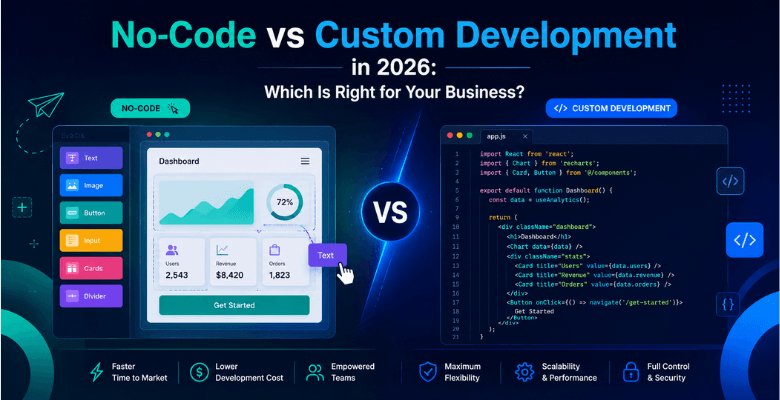
Not sure which approach is right for your project?
We've built both. We'll tell you honestly which one fits.
From no-code MVPs validated in 6 weeks to enterprise AI platforms with 50,000+ users, we've built across the whole range. Book a consultation and we'll tell you honestly which approach fits your budget, your timeline, and your scale ambitions.
Book a discovery call