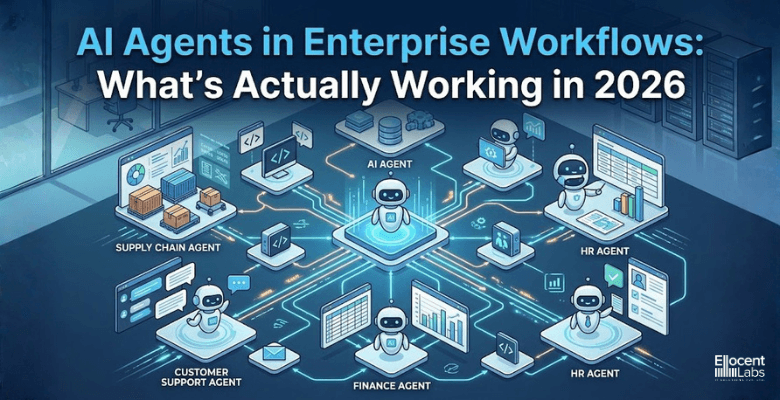
AI Agents in Enterprise Workflows: What Actually Works
Listen to this article
An AI agent is software that is given a goal, works out the steps, and carries them out across your business systems, checking its results and asking a person when it is unsure. In enterprise workflows, agents are delivering the most value in high-volume, rules-heavy processes such as invoice handling, employee onboarding and IT service requests, not in open-ended "do anything" assistants.
This guide explains what AI agents are, where they work today, why many projects stall, and how Australian organisations can choose a first use case and govern it properly.
What are AI agents?
A chatbot answers questions. An AI agent takes action. Give it a goal such as "match this week's supplier invoices to purchase orders and route exceptions for approval" and it will:
- Plan the steps needed.
- Use tools it has been given access to, such as your ERP, email or document store.
- Check the results against rules or expected values.
- Hand anything uncertain or high-risk to a person.
- Log what it did and why.
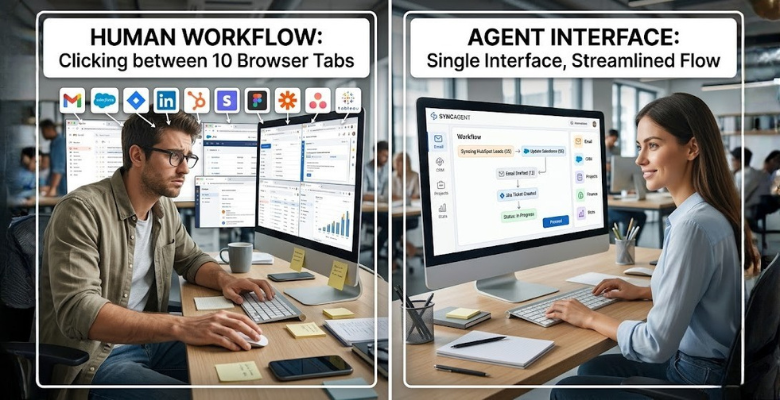
Agents are built on large language models for reasoning, connected to your systems through APIs, with permissions and guardrails that limit what they can do.
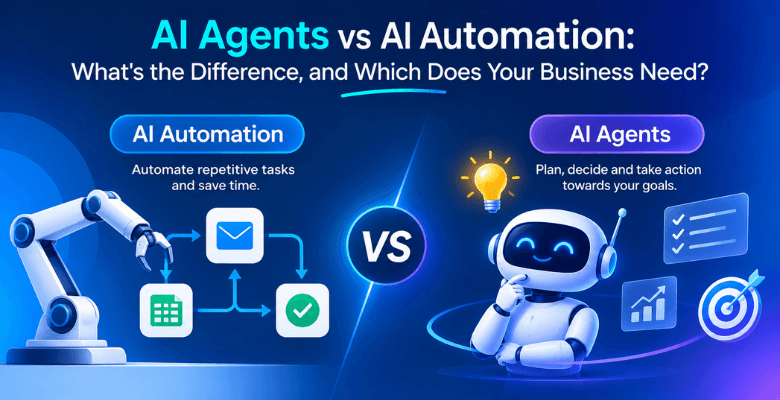
AI agents vs chatbots vs RPA
| Chatbot | RPA bot | AI agent | |
|---|---|---|---|
| What it does | Answers questions | Repeats fixed, scripted clicks and steps | Plans and carries out multi-step tasks toward a goal |
| Handles variation | Within a conversation | Poorly; breaks when screens or formats change | Well, within defined limits |
| Best for | FAQs and simple support | Stable, structured, repetitive tasks | Variable inputs that need judgement and several systems |
In practice, strong programmes use RPA or plain integrations for the stable steps and agents for the parts that need judgement.
Where AI agents are working today
Finance and document processing
Invoice capture, purchase-order matching, expense checks and contract review are good fits: high volume, clear rules and a measurable cost per item. An agent can extract data, validate it, apply GST and approval rules and post to the finance system, sending only exceptions to the team. Our AI invoice processing guide covers this in detail.
HR and IT service workflows
Onboarding needs accounts, licences and access across many systems, with rules that differ by role and location. Agents can sequence those tasks, chase approvals and confirm completion. IT service desks use agents for ticket triage, access requests and routine fixes.
Customer operations
Agents can gather case details, look up order or account history and route the case to the right team with a summary, so people spend their time on resolution rather than collection.
Recruitment
Screening applications against role criteria, scheduling interviews and keeping candidates updated are well suited to agents, with people making every hiring decision. We built CV parsing and candidate scoring for the AQYR recruitment platform.
Why AI agent projects stall
- Integration is an afterthought. An agent is only as useful as the systems it can reach. Missing APIs, fragile connections or unclear authentication stop projects after the demo.
- No governance model. Teams deploy agents without deciding what they may do alone, what needs approval and how errors are rolled back.
- The process is not defined. If three people do a task three different ways, an agent cannot learn the "right" way.
- No measure of success. Without a baseline (time per item, error rate, cost), nobody can show the agent is working.
- Demo vs production. Demos rarely show access control, failure handling or what happens when a downstream system is down.
Governing AI agents in Australia
Agents act on real data and real systems, so governance must be designed in from day one:
- Privacy: if an agent handles personal information, the Australian Privacy Principles apply, including rules on use, disclosure and overseas transfer. Check where the model provider processes data.
- Automated decisions: recent changes to the Privacy Act require organisations to explain in their privacy policy when personal information is used in automated decisions that significantly affect people. Confirm your obligations with your legal team.
- Human checkpoints: define which actions always need approval, such as payments above a threshold or changes to employee records.
- Least-privilege access: give each agent only the permissions its task needs.
- Audit trail: log every action, input and decision so it can be reviewed.
- Rollback: make every action reversible or confirm before acting when it is not.
The Australian Government's National AI Centre also publishes voluntary guidance on safe and responsible AI adoption that is worth using as a checklist.
Is your business ready for an AI agent?
Signs you are ready
- The workflow is high-volume and mostly rules-based.
- It crosses two or more systems that have APIs.
- Your data is reasonably clean and consistent.
- You can say clearly what a correct outcome looks like.
- Someone owns the process and can approve exceptions.
Signs to prepare first
- The process is undocumented or varies between teams.
- Key systems have no API or are being replaced soon.
- Nobody has decided what the agent may do without approval.
How to start: a 6-week first project
- Week 1: pick one workflow, measure today's baseline and map the systems involved.
- Week 2: agree guardrails: permissions, approval points and what "correct" means.
- Weeks 3–4: build the agent and integrations; test on historical cases.
- Week 5: run alongside the team (the agent proposes, people approve).
- Week 6: compare against the baseline and decide whether to widen its autonomy.
How Ellocent Labs builds AI agents
We start with the integration map and the governance rules, then build the agent. Our engineering team is based in India and works with Australian clients remotely, with agreed overlap hours for workshops, demos and reviews. See our AI agent development and AI development services pages for what we deliver.
Frequently asked questions
What is an AI agent in simple terms?
Software that is given a goal, plans the steps and carries them out across your systems, asking a person when it is unsure.
How are AI agents different from chatbots?
Chatbots answer questions. Agents complete tasks: they read, decide and act in other systems, within limits you set.
How long does it take to put an AI agent into production?
A focused agent for one workflow with available APIs typically takes four to eight weeks. Multi-agent systems across many systems take several months.
Are AI agents safe to use with customer data?
They can be, with least-privilege access, human approval for high-risk actions, audit logs and a model provider whose data handling meets your privacy obligations.
Plan your first AI agent
Book a discovery call and we will help you pick a workflow, set a baseline and outline the guardrails.
Not sure which approach is right for your project?
We've built both. We'll tell you honestly which one fits.
From no-code MVPs validated in 6 weeks to enterprise AI platforms with 50,000+ users, we've built across the whole range. Book a consultation and we'll tell you honestly which approach fits your budget, your timeline, and your scale ambitions.
Book a discovery call